Owerri’s Defining Moment: The growing call for Nze Charles Asika Agoh (Akataka) to walk the Obi Path.
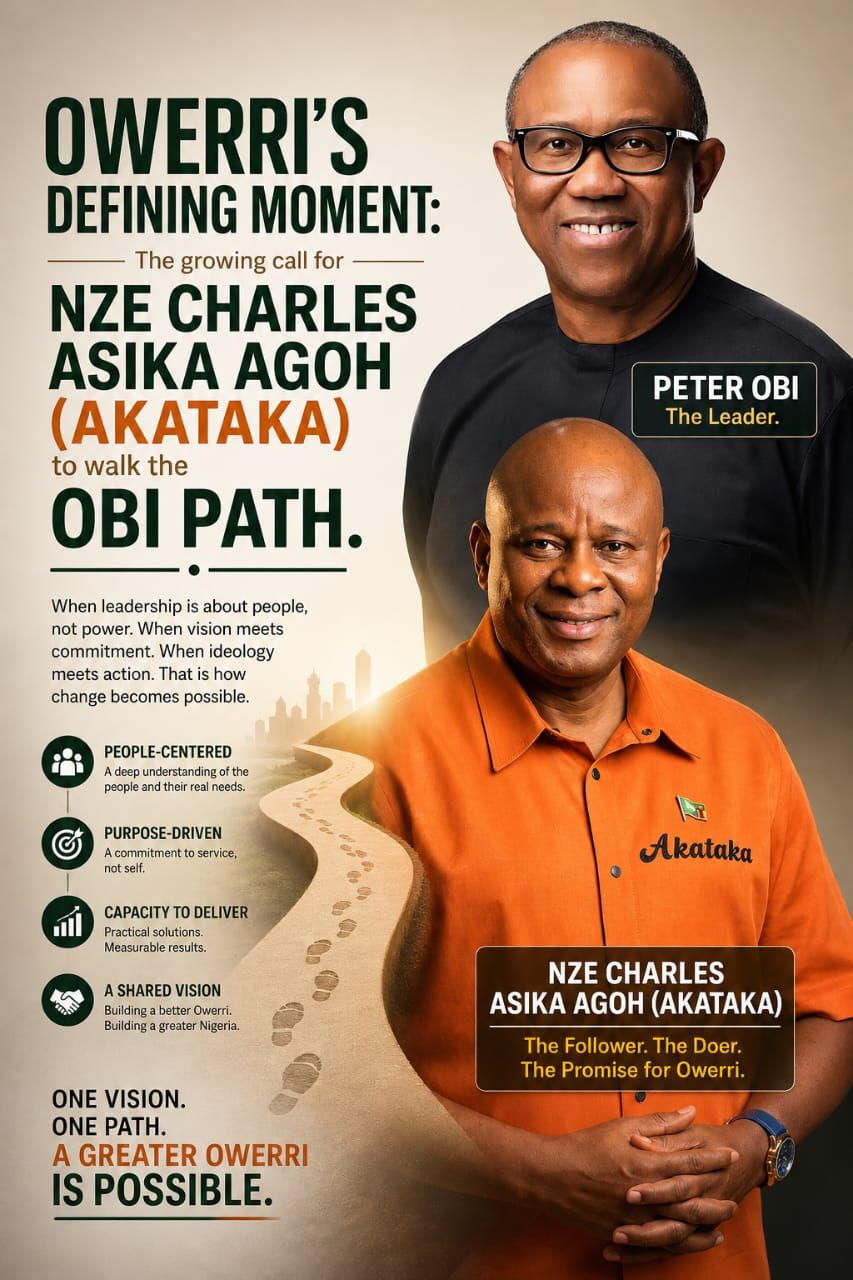
– Metro Media (+2349076770571)
In Nigeria’s ever-evolving political landscape, moments arise that demand not just participation, but strategic alignment. Such moments test the depth of leadership, the clarity of vision, and the courage to act in the interest of the people. Today, one of such moments is unfolding; quietly but significantly around the growing conversations linking Peter Obi and shifting political platforms, and what that could mean for leaders like Nze Charles Asika Agoh (Akataka).
Across political circles and public discourse, it is the obvious narrative that Peter Obi has moved his political base from his current alignment within the African Democratic Congress (ADC) to another platform.
While no final position may yet be formally established, what is undeniable is the ripple effect such a move would generate across the political spectrum.
For many supporters and observers within Owerri Federal Constituency, this conversation is no longer abstract. It has become personal, strategic, and deeply consequential, especially in relation to Nze Charles Asika Agoh’s political journey.
Akataka’s emergence in the race for the House of Representatives has never been seen as an ordinary aspiration. His candidacy has consistently been framed around Credibility, Commitment, and Capacity; values that strongly mirror the political philosophy that has come to define Peter Obi’s national appeal. Obi’s brand of politics, centred on prudence, accountability, grassroots sensitivity, and data-driven governance, has inspired a generation of leaders and followers who are seeking a departure from conventional political excesses.
It is within this ideological space that many have come to situate an outstanding personality like Nze Charles Asika Agoh (Akataka).
Observers note that Nze Charles Asika Agoh’s approach to leadership reflects a similar discipline: a focus on people-centred development, a consistent engagement with communities, and a practical understanding of economic empowerment as a tool for social stability.
Even without holding an elective office, he has maintained a visible commitment to supporting livelihoods and strengthening local economic participation; an approach that aligns closely with Obi’s long-standing emphasis on productivity over patronage.
This perceived alignment is at the heart of the growing calls for Akataka to do the needful.
Supporters argue that politics, beyond party structures, is ultimately about shared vision and strategic positioning. If indeed Peter Obi makes a decisive political shift, they believe that leaders who share his philosophy must be willing to align accordingly; not out of convenience, but out of conviction. For them, Akataka represents not just a candidate, but a continuation of a leadership culture that prioritises service, accountability, and measurable outcomes.
There is also a strong electoral argument underpinning this sentiment.
Peter Obi’s political movement has, over time, evolved into more than a candidacy: it has become a national consciousness, particularly among young people and urban voters. His influence cuts across regions and demographics, creating a network of engaged citizens who are increasingly shaping electoral outcomes. In this context, aligning with such a movement is seen not only as ideologically consistent but also strategically advantageous.
For Nze Charles Asika Agoh, whose vision is to represent Owerri Federal Constituency at the national level, such alignment could significantly strengthen both his primary positioning and general election prospects. It offers the possibility of tapping into an already energised support base, while reinforcing his image as a candidate of modern, accountable leadership.
Yet, beyond strategy lies something deeper: expectation.
Many within Owerri believe that the constituency stands at a point where representation must move beyond traditional political calculations. There is a growing desire for leadership that is forward-looking, disciplined, and capable of connecting local realities with national opportunities.
In their view, the synergy between Peter Obi’s national outlook and Nze Charles Asika Agoh’s local grounding presents a unique opportunity to achieve this balance.
They see in Nze Charles Asika Agoh someone who understands the people; not just in rhetoric, but in lived experience. At the same time, they recognise in Obi a leader whose governance philosophy has challenged the status quo and inspired a different kind of political thinking. Bringing these two strands together, they argue, could create a powerful model of representation; one that bridges aspiration with action.
Of course, such a decision is not without its complexities.
Political platforms come with structures, loyalties, and long-standing relationships. Nze Charles Asika Agoh’s history within the ADC is one of commitment and contribution, and any consideration of movement would require careful reflection on both principle and practicality. However, politics also demands adaptability; the ability to respond to changing realities while remaining true to core values.
This is precisely why the conversation continues to gain traction.
It is not framed as a rejection of the past, but as a strategic step towards a more aligned future. It is about positioning leadership where it can be most effective, most impactful, and most consistent with the aspirations of the people.
As the situation unfolds and political alignments become clearer, one thing remains evident: the expectations on Akataka are rising. He is increasingly seen not just as a participant in the political process, but as a figure whose decisions could shape the direction of representation for Owerri Federal Constituency.
In the end, the question is not merely whether a political move should be made. It is whether such a move would strengthen the ability to deliver, strengthen the connection with the people, and strengthen the pursuit of a leadership model that many now believe Nigeria urgently needs.
For a growing number of voices within Owerri, the answer is leaning in one direction.
If the vision is shared, if the philosophy aligns, and if the goal is to deliver a new standard of leadership, then the path forward may well be clear: Nze Charles Asika Agoh (Akataka) should walk the Obi path.